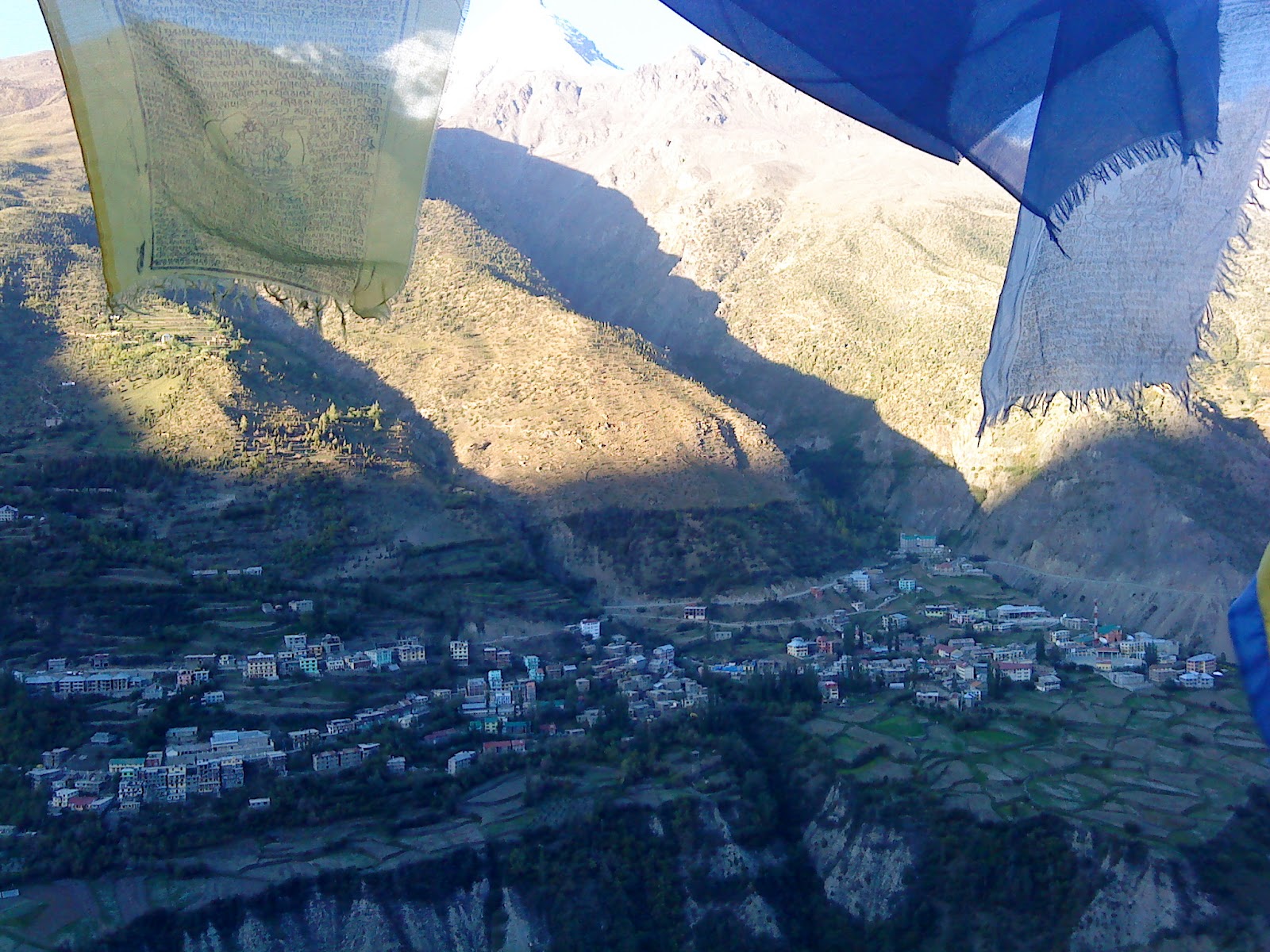
This blog contains accounts of my travels in India and abroad. Some of the posts were created much later, the dates have been adjusted to give a sense of the real time.
Saturday, September 4, 2010
Sunday, February 28, 2010
Along the Ganges - Sunderbans
Labels:
Ganges,
postcards,
Sunderbans
Monday, September 21, 2009
Stopover in Lahaul - Keylong
It was thrilling to peer down at the panorama below – the green
canopy dotted with tiny houses, the fields and the winding roads on the
mountain slopes -a somewhat familiar yet satisfying experience, especially
since I wasn’t looking at river fed plains from just another hill station – this
was the Kullu valley, already at over 1,500 mts! We are taking the last few
curves in the road before we cross Rohtang la (3998 mts) into Lahaul. (This
time with a colleague of mine, SP)
| You follow the Chandra river (above) till Tandi, from then on it's the Bhaga |
The Rohtang pass is often visited by tourists in Manali – It
is a sure way to touch and feel snow, which for largely tropical dwelling
Indians is a fantasy in itself. But, today I want to cross over to the other
side of the pass. A quick glance towards the end of the road before it turns
left and down into Lahaul, reveals snow capped ranges with mountain sides
barren and bereft of life. We were now moving into the famous cold desert of
North India, which stretches from Himachal Pradesh to Ladakh.
After stopping briefly at the pass to watch the setting sun
turn the mountain tops orange, we hasten in the descent – the roads aren’t the
best and we need to make the best of whatever light we have. We arrive at 8pm
in a half-shut Keylong and make a beeline for Tashi Deleg, one of the better
hotels near our drop off point and the marketplace.
Desert capital
Keylong, at over 3,000 mts is the capital of the
Lahaul-Spiti district in Himachal Pradesh. She sits timidly on the banks of the
Bhaga waiting to be discovered by travelers. The truth is many travelers do
stop here. Given that it is a district capital, you will get mobile
connectivity, a hospital if required, plenty of shops and hotels. It therefore
becomes a convenient night halt for those going from Manali to Leh. But
unfortunately, that’s how it remains – a night halt. That shouldn’t take anything
away from the fact that it is a really picturesque little village. But before
we explore Keylong and her people, we head out for a rendezvous with one of the
highest lakes in India – Suraj Tal
![]() |
| Barren Lahauli landscape |
Water on high
When you are travelling through the hills, you inevitably end up following a river which is natural considering the landscape that it creates. Today, we travel along the Bhaga, still on the Manali-Leh highway. We soon leave the fields of Keylong, there isn’t any green to be seen anymore, only shades of brown with fine blue lines of the Bhaga creating a vein-like pattern over the land. After crossing the check post at Darcha, the climb gets steeper and the terrain still harsher. Landslides are more common and we are halted several times. This lifeless spectacle will continue for the rest of the journey.
![]() |
| Landslides are common (Darcha down below) |
For an urbanite, brought
up in the one of the most populous cities in the world, the isolation is
absolutely exciting. It makes we wonder
how much of a risk we are taking, traversing these parts in a Maruti van.
![]() |
| You can get some great reflections at Deepak Tal |
Our first stop is at Deepak Tal near Patseo. It is just
large enough to not be called a pond, but is definitely worth the visit. It’s
crystal clear and the still waters are a photographer’s delight. It’s also a nice place to stop before you
ascend towards Baralacha La.
Baralacha La is one the higher passes on this route and the
ascent can be taxing on your lungs, but it’s worth the effort. The scenery now
starts to turn white – frost covers the sides of the road and the snow covered
peaks that complete the horizon of the lower villages now seem closer than
ever. We never really reached the pass – Suraj Tal, our real destination is
just short. The L-shaped lake springs up on you without warning – not that you need
one to appreciate its pristine settings. But the lifeless nature of the surroundings
continues- we are the only ones here and it doesn’t seem like a much frequented
spot anyway.
![]() |
| Suraj Tal |
Khardung monastery
There are a few treks around Keylong - to her monasteries
that sit atop her high mountains. We find ourselves heading towards the east
bank to the Khardung monastery that overlooks the town. You pass the hospital,
cross the prayer flag strewn metal bridge and begin climbing towards the
monastery. The route takes you through Lahaul at its best. Away from the
hotels, the bus stand and the main market on the west bank, Khardung village is
a picture postcard of Lahauli village life with potato fields, cubical houses
with flat roofs storing hay for the harsh winters, narrow dusty roads devoid of
tire marks and the scampering of children and sheep alike in between. The
people are friendly and will gladly engage you in conversation. Even the women
are fairly bold – we had a bunch that stopped us to ask us for some chocolate!
| Potato fields in Khardung village |
| This man claimed that the original Khardung monastery was down in the village and that he was its keeper. |
| Got any chocolate? |
1.5 hrs of climbing and we are finally there. Khardung
monastery is a dainty white building with the front façade decorated with
images of animals and men. The courtyard is lined with flower pots, a
statue of the Buddha and prayer flags. Apart from that, it was quite the expected
- monks solemnly moving around, prayer wheels, prayer flags and pin drop
silence. One of the monks comes out to give us a tour of the monastery. The
monastery belongs to the Drukpa Kargyud sect and is adorned with paintings on all
sides. It also houses some ancient artifacts. But this isn’t the original
building – the monastery has been destroyed and rebuilt several times before.
| Khardung monastery |
The highlight though, is the eagle-eye view of Keylong,
right across the river where she lies nestled on the banks, waiting for the next traveller to Leh to stop by– a perfect fusion of
human life, marketplaces, quaint houses, terraced fields and a lifeless desert
in the background with God himself standing guard over her!
| Keylong from the monastery |
Pointers
- If you are taking your own vehicle, tank up at the Petrol pump at Tandi. It is the last one until Leh.
- The roads are often washed away due to rains, melting snow etc and inspite of frequent repair remain in bad shape – account for plenty of time for travel (Manali to Keylong took 6 hrs for a distance of 120kms)
- There are plenty of hotels in Keylong of which the Chandrabaga is probably the best. However, it is not the closest to the market place. You can also choose to stay at the hotel Ibex at Jispa.
Labels:
Darcha,
Deepak Tal,
Jispa,
Keylong,
Khardung,
Suraj Tal,
travelogue
Monday, August 17, 2009
On the Guru's trail - The Valley of flowers
“Our happiest moments as tourists always seem to
come when we stumble upon one thing while in pursuit of something else.” —
Lawrence Block
Little Ludhiana
“This is like a little Ludhiana!”, exclaimed +Vinay Sekar as he looked at the hordes
of pilgrims. I join him to see a sea of turbans bobbing up and down in the main
street of Govindghat. Along with it, I can hear the distinctive yet familiar
beat of Bhangra music – I really can’t blame VS for that comment.
Govindghat which is
propped on the banks of the Alakananda is just one narrow street, packed with
vendors selling everything from apparel to Punjabi music CDs. Now, if you are
looking for Govindghat in the map of Punjab, you are in the wrong state. I am
in the hill state of Uttaranchal, with the hope of getting to the fairy tale
‘valley of flowers’. Most of the
pilgrims on the other hand are on their way to Hem Kund Sahib, a Sikh
pilgrimage point.
![]() |
| Route from Govindghat to the valley of flowers |
If you are not familiar with the trail, here goes
- You start off from Govindghat, which is 24 km from Joshimath. This is as far
as wheels can take you, from here is either horseback or on foot. Starting at
Govindghat is the long arduous trek of 14kms to Ghangaria, which serves as a base
for treks to the Valley of flowers and HemKund Sahib. The Valley of Flowers is
about 3km from Ghangaria and Hemkund Sahib, around 6km.
VS and I are joined by a colleague of mine
AS, and his friend. We start of in the early evening, hoping to make it to
Ghangaria by around 9-10 pm. But fate had other plans, and what we then thought
was an ‘unfortunate’ series of events, soon became a unique travelling
experience.
First,
one succumbs to the trek and the higher altitudes, then off comes the sole of
another’s shoe, rain, darkness, rumours of bears ahead and in about 2 hours we
are embarrassingly headed back to Govindghat only to find that every room is
booked solid. Our only hope is the Gurudwara here in Govindghat.
| Govindghat |
A
lesson in Sikh etiquette
Owing to the large number of pilgrims to
HemKund, the Gurudwara not only provides spiritual comfort, but some more
temporal ones as well – a guesthouse for the not so affluent and perhaps ones
like us – stranded without shelter, even if you aren’t Sikh. It has a few rooms
and a large dormitory – spartan no doubt, but bear in mind that all this runs
on just donations! A bit of pleading is required – the guesthouse is also full,
even the dorm! But AS (who is Sikh himself) finally gets them to let us sleep
on the common balcony. But the good Sikh hospitality didn’t end there – we are
soon ushered into a large dining hall for langar.
What is langar?
The word langar (लंगर) can be
traced back to Persian- it means ‘an alms house’, 'an asylum for the poor and
the destitute' or 'a public kitchen kept by a great man for his followers and
dependents, the holy men and the needy.' In the case of Sikhism, it’s
more of the third. Langar is also known as Guru-ka –langar (langar in the name
of the guru). It was first started by Guru Nanak to demonstrate the principle
of equality. In the hall, everyone irrespective of social status gather to eat.
However, this isn’t a simple dinner – food is often blessed in the Gurudwara
and then mixed with the rest –so it is considered sacred and referred to as ‘Guru-prashad’.
The kind of food and the frequency of service depends solely on the resources
of the Gurudwara- money/food donated and volunteers to prepare and serve the
food.
[I have written this note with the help of internet
resources (http://www.searchsikhism.com/institution.html,
http://www.sikhiwiki.org/index.php/Langar)
and a few friends-Thanks +Alamjit Singh Sekhon and +Supriya Bhogal . If you need more
information, there is enough on the net. You can also contact your friendly
neighbourhood Sardar]
We cover our heads with handkerchiefs or
any cloth that we have on hand and remove our sandals before we enter. It’s my
first time in a Gurudwara premises and I’m certainly quite self-conscious.
After we sit, volunteers or sevadars
come around serving us dal, vegetable and rotis.
He comes to me to serve offer me a roti and drops it in my plate – no big deal
right? But then, I look towards AS who receives his roti with two open palms and
head bent down in reverence. Okay so that’s one goof up – I guess I’m allowed
one mistake right? Towards the end of my meal, the sevadar returns to serve me
some more. This time, I am determined to be extra respectful and reply with my
politest ‘No Thank You’ and a smile. I then turn to AS again, with the fear and
suspense of a quiz participant, hoping that his calculated guess turns out to
be right. But AS, who is also done with his meal, again lowers his head, covers his plate with both palms facing down and
says ‘Bas’ . I look around to see if
anyone is disturbed by my blatant discourtesies, but everything seems to be
fine. I guess, when you are dark skinned and 5 feet 6 inches tall, people sort
of know you‘re not from the Punjab! But one piece of tradition I did manage to
follow was to wash my plate – it is compulsory for all to do so. Regardless of
my ill-mannered behaviour, I do feel a certain humility present in the
gathering, an equality that redefines people’s roles to fulfil the most basic
of human needs. It reinforces a belief I have always held – only Religion can
achieve true equality of men, where the haves and have-nots are only too happy
to oblige.
We collect our sheets and blankets and head
to the balcony – there is a roof over our heads for the night!
Garden
of Eden
We start again at the break of dawn the next
morning, but take mules to catch up on lost time – embarrassing, yes, but it is
the fastest way up to Gangaria. With the Valley of flowers trek, it’s a case of
the journey being as captivating as the destination. The route to Gangharia
runs along the Lakshman Ganga River and sound of the roaring river accompanies
you all the way. There was ofcourse for us the added monsoon bonus of lush
green mountains with waterfalls gushing and sparkling on their way down. The
journey lasted just 4.5 hours- those
mules are quick!
| Village on the way |
Gangaria is a collection of luxury tents, guesthouses
and horse owners trying to get customers going back down to Govindghat. And
standing amidst all this is a helipad. So much for the mules being the fastest
transportation! It is at this point that the pilgrims and us part ways – they move
on to HemKund Sahib perched at an altitude of 4000m. We push on, with little
time to spare – it’s another 3 km to the Valley.
If you find the trail to Gangaria
enchanting, then the route to the Valley of flowers will blow you away. As we
move closer to the destination, the trail gets steeper and more rugged, I begin
to notice flowers growing wild by the sides almost reassuring us that we are on
the right track. The river begins to get boisterous and noisy. And then
finally, we go across a makeshift wooden bridge to reach the valley – the
narrow trail opens up to a wide and fairly flat land of floral patina. The
noise of the river dulls down, the clouds creep into the valley and with them,
the serenity of being lost in the Himalayas.
The only sound now is the patter of raindrops and our lungs gasping for breath after the climb. No doubt the clouds have prevented us from getting a postcard view of the place, but we were finally here. People often say that it’s the journey that matters and not the destination, it could not be more true with this excursion. At no point was I not in awe of the landscape around me and the people around me – an entire setup created to get a multitude of pilgrims to Hem Kund and few others to what was in semblance, the garden of Eden.
Pointers
- If you do happen to participate in the langar, do not waste food – it is definitely frowned upon
- The easiest way to Joshimath/Govindghat are the ‘press’ cabs which start from Rishikesh. They take newspapers to smaller towns on the way and start off early. The only better option is to hire the entire vehicle for yourself.
- Don’t miss the host of sangams (confluence of rivers)on the way to Joshimath, including the Devprayag – the origin of the Ganga, after the Bagirathi and Alakananda meet.
Labels:
Govindghat,
langar,
travelogue,
trek,
Valley of flowers
Monday, August 3, 2009
The Queen's hills - Mussoorie
It felt like I was living out of an antique
shoe box. Hotel Broadway at one end of Camel’s back road has been around for
more than 50 years! Her exterior betrays no luxury and I can safely say that
her interiors don’t either. It’s listed in Lonely planet as a backpacker’s
favourite and for 200 bucks a night I really can’t argue. However, if you think
I’m complaining about making this by home for the weekend, you’re mistaken.
Hotel Broadway might not be the finest – her rooms are poky, the food, basic, but
the flowered pots, the wooden floor panels and the excellent views of the green
slopes from the balconies still lend a rustic charm to the place. She stands almost stoically slightly raised
off the road, as if the British never left Mussoorie. But in truth, while the
Raj has long gone, their memory remains here in names, monuments and gothic
styled edifices.
Mussoorie was initially constructed as a
shooting lodge way back in 1825. 2 years later a sanatorium was built here at
Landour. Slowly but surely, as India moved into the next century, Mussoorie
became a popular holiday destination, especially during the summers. It now
attracts thousands of tourists every year and not surprisingly, the forests
have been pruned to make way for hotels, guesthouses and the like.
But I choose to defer my colonial tours for a walk
through the woods, a short trek to Kempty falls. Kempty falls is a frequented
destination by tourists to Mussoorie. One can go there by road or trek to the
falls from Happy Valley which is home to a Tibetan settlement including a
school for the community. A short visit to the monastery, I think is in order
and I find myself at the Shedup Choepelling temple at the end of Happy valley.
I don’t really know what to make of the temple, but at least I finally learn
what Mo Mani Padme Hum means.
The trek to Kempty begins from the monastery itself. The trail winds its way through moderately dense forest and a few local settlements. It being August, the dampness of the monsoons engulfs me. Moss and short grass creates a green canopy on the forest floor. The trail beneath my feet seems softer than normal and the clarity of every insect buzzing, every bird chirping reminds me of my isolation on this trail.
A short distance away are the bustling bazaars
of Mussoorie, but out here, humans are oddly conspicuous by their absence. After about 2 hours, I realise that I'm closing in on the falls – I follow a rather small stream and
the sound of gushing water to arrive at a cluster of stalls selling packaged
snacks and ‘Maggi’ noodles. A little upstream from here, the little stream I followed,
cascades down several feet to become the Kempty falls.
Kempty falls is quite the tourist
attraction and there is even an Indian stamp issued with a picture of it. As
for the name, I’m not quite sure, but it seems like it’s a local derivative of
‘camp-tea’, after the tea parties held here during the days of the Raj. But
pleasing as the cool breeze and the spray of water is, I must rush back to
Kulri Bazaar for what could be the highlight of my trip.
When the British left India in 1947, some
of them stayed on, being smitten with India’s exotic and yet down-to-earth
charms. You can find quite a few of their fair-skinned descendants across the
country. And it is not surprising that here in Mussoorie, the local celebrity
is of British origin. Ruskin Bond, a Padma Shri awardee is famous for his
contributions to children literature. In fact many of his stories draw
inspiration from Mussoorie and the Doon valley. He today resides in Landour and
you can get a chance to meet him every Saturday afternoon in Kulri Bazaar.
Well, thats at least what the sign outside Cambridge store said earlier that
day.
Unfortunately for me, I found it quite
difficult to get a ride back into town and as I hurry into Cambridge store, I
realise that I am 15 minutes late – Mr. Bond had already left. As consolation,
the storekeeper pulls out an entire heap of Ruskin Bond authored books, already
signed by the man himself and available at the normal rate. I guess there are
plenty like me around.
Its early evening now and I choose to spend
the rest of the day in and around the bustling Mall road, where you are more
likely to meet neighbours from Delhi than a local. I take the ropeway up to Gun
Hill, where I was promised I would get a rare glimpse of the Himalayas. The
trip isn’t very exciting – there isn’t much to see owing to the cloud cover,
but the kids around love it nonetheless.
Gun Hill at a little over 2000m is the
second highest point in Mussoorie. In the days gone by, a canon atop the hill would
fire everyday at midday to allow people to adjust their watches. Post
independence, the gun was melted to make taps, yes taps! The hill still
attracts many tourists for views of the ranges. But once again, I reach the top
to find mountains and the Doon valley below hidden behind the spoiler of the
day – the clouds. Optimistic though were the local guides, who were convinced
they could show me a few mountain peaks through their telescopes.
A few minutes later I am back at Mall Road
after negotiating the moss covered steps down from Gun Hill, and decide to end
my ramblings for the day at a ‘familiar’ Barista. My search for the real Mussoorie took
me through her woods, mountain slope settlements, and her bazaars. Yet, I am
now looking at the most ‘touristy’ version of the town, one that I had
intentionally tried to avoid the entire day - the clouds slowly drift in- tourists stroll along the road
adorned with old lampposts right out of the 1920’s. They are enjoying the
weather, looking for the odd bargain with the street vendors and soaking in
views of the Doon valley, whenever the clouds care to part. Above the din of
the crowds, I can hear the clip-clop of hooves as kids enjoy horse rides. Its
almost as if the ghost of Christmas past is about to sneak up beside me. Ironically,
the only thing that seems a little out of place is the spritzer i’m drinking. I wonder if I should be wearing a top hat and sipping on some tea. But,
like most other Indian hill stations , Mussoorie has moved on to a comfortable Anglo-Indian
blend.
The names are British, but the people are
Indian, the buildings around show you her roots, but the lights tell you that
she has moved into the new millennium. I trudge back to my shoebox for the
night absorbing the last bits of Mussoorie before I leave in the morning.
About 3 years later, I find Hotel Broadway online at http://www.hotelbroadwaymussoorie.com/.
Her prices have gone up and her interiors look much better – looks like she too
is moving on.
Labels:
hills,
Mussoorie,
Ruskin Bond,
travelogue
Location:
Mussoorie, Uttarakhand, India
Subscribe to:
Posts (Atom)