This blog contains accounts of my travels in India and abroad. Some of the posts were created much later, the dates have been adjusted to give a sense of the real time.

Thursday, October 20, 2011

Malana - untouchable for a day

I learnt about Malana over the internet. There was something intriguing about her profile – her political roots, her air of superiority and the more recent flirtations with the psychedelic world. Her character it would seem has been sculpted out of the seclusion of the mountains – her minimal contact with the outside world left her to find her own solutions - rules to establish order, a creed to fill the loopholes and a language to communicate the same. The result is proof that perhaps too many philosophers and economists can overcook the broth. Her allegiance to a system which the majority of the free world believes to be the most optimal, has made her the subject of study of many a sociologist and historian. But then she was discovered.  And as contact with the outside world grew, in came the vices of modernity endangering her ways and thus herself.
Village of Malana
My tryst with Malana was long overdue – I always felt like I was fighting against time. Every month spent without seeing her meant she moved a bit closer to the current year and to extinction.  A change in job and location forced me to reset my priorities on the travel front and in the middle of October 2011, I find myself huffing and puffing up the slopes towards her. The path isn’t too steep, but prosperity has had its way in the past year, albeit in only a physical manifestation. My guide, who I hired from Jari, is amused. The panting and frequent stops bring a smirk to his face, a proud and pompous expression that lets you know that you, the urban creature, in your pursuit of your intellectual progress have depreciated the dexterity inborn in your limbs! He keeps pointing to the tele tower up above and tells me that we only need to climb till that point. I look at the tower and get the sinking feeling that Malana might have already passed me by. Meanwhile, I begin to notice the cannabis on the slopes around. “This is the season of Charas”, the guide tells me, “and the police are in and out of Malana frequently.”
Central courtyard
I finally cross the metal tower and move into the boundaries of Malana. There really must be a crackdown on the hash trade – I read travelogues describing locals trying to sell you Charas or cream the minute you set foot in the village – none of this happens. Perhaps, they think I’m too cheap! (Hash sells for Rs. 80,000/kg according to my guide)
Malana architecture resembles the Kinnauri style
The first vision of the village hits me as one in transition – housing is a mix of a more traditional wood and slate and a newer stone/brick and tin/asbestos. There was a fire here in 2008 and many families switched to stone and asbestos after that. The rubble scattered across the village suggests that the work might still be on, or the neighbourhood doesn’t care! I sight a local school, a shop with well known brands and even a non-veg restaurant! Clearly the traditional shackles have been broken. But progress aside, I am still an untouchable! Locals here believe that they belong to a superior race – they or their houses cannot be touched by outsiders. I take the path that goes through the village, designed so that you don’t have to go near their homes. My guide keeps warning me each time I go even a bit off the path trying to get the right photograph.

The Oldest democracy in the world!
Malanis are believed to be descendants of the soldiers of Alexander the great, who took refuge here after their defeat. For centuries they have upheld a democratic structure consisting of a lower house and an upper house. Many historians believe this to be the oldest democracy in the world.


Malani local
But for a superior race, they aren’t exactly the most tidy. The central courtyard that houses the temples and the parliament house is strewn with plastic bags and all sorts of other garbage. Add to that the rubble I mentioned earlier and you have quite a mess. I notice a few kids playing and try to offer them some chocolates.  Again my guide intervenes and asks me to hand them over to him. He in turn gives the chocolates to the kids – apparently he is pure for some genetic, spiritual or commercial reason. He then goes on to tell me that if I were to lay my hands on them or their houses, I would have to pay a Rs. 1000 fine. I have one mind to go ahead and do it, purely out of curiosity. But then I pull back when he tells me the money is to buy a hen which would be sacrificed to purify the place! All said and done, the chocolates have warmed up the kids. They are happy to pose for a few photographs and continue to shout for some more chocolate, even if they do it from ten feet away!
Kids will be kids!
The last piece in the puzzle is the language of Malana – one which had the overtones of the northern languages, but was certainly not familiar. My guide tells me that years ago, a Rishi (sage) had ordered a local demon to leave Malana. The demon said that he would do so on the condition that he be remembered in some way. The Rishi agreed and his language was given to the locals of Malana.
The image of the local deity - the Jamdagni rishi with the Rs. 1000 fine notice
Dusk is approaching now, and we are eager to get back to Jari -the route to Malana is infamous for muggings.  It’s a mixture of disappointment and satisfaction as I leave the village. Disappointment at the dispirited effort by the community to keep their identity alive and satisfied that I have witnessed and experienced Malana before she is extinct!
On my way down, I bump into a group of foreigners. “How is Malana?”, asked the Norwegian in the group. I reply that she had modernized and was not like earlier visitors had described in their travelogues. The response evokes puzzled looks from the entire group. They look at each other for answers , baffled as if they suddenly realize they took a wrong turn somewhere on the way up. The lady tries again, now slightly embarrassed, “Are they cultivating?” 
It’s a slow death for Malana. I can only hope this travelogue along with the others online, are a fitting testimony of her.


POINTERS
  1.     The closest village to Malana is Jari. The Om Shiva guest house is the best here – if it is closed, call the number posted on the front and the caretaker will come there in 10-15 mins
  2.     You can also stay at Kasol & Manikaran – there are supposed to have better hotels/guest houses. Malana also has a guest house or two – you can stay there or camp ahead esp. if you trekking to Naggar over the Chanderkhani pass.
  3.    You can get to within 2 kms of Malana by road. After that it’s a climb up to the top.

Saturday, August 20, 2011

Street art – a day in Mandawa


I am no art connoisseur! I photograph as a hobby, but it sort of ends there. I can’t tell the difference between a Picasso and street graffiti. In fact, it’s because of people like me that Mr. Bean can break eggs over Whistler’s mother and still get away with it! But that shouldn’t stop me from appreciating art in my own individual way. After all, isn’t art the right-brained introspection and reflection of all of society’s left-brained rules and conventions?  However, Shekhawati doesn’t really adhere to either side. It’s more a reengineering of the canvas, lateral thinking and innovation.
'Kuan' or well in Mandawa


Entrepreneur’s club
The semi-arid region of Shekhawati is made up of the modern day districts of Jhunjhunun, Sikar and Churu in Rajasthan. Its claim to fame is the numerous entrepreneurs that have their roots here. But then again Shekhawati has had a long tradition of trading – old caravan routes, some starting at the ports of Gujarat others from China passed through these parts, creating an affluent Marwari community.

Public art gallery
Shekhawati is regarded as ‘the open art gallery’ of India and the village of Mandawa is probably the best example on display. It is touristy enough for you to have access to comforts yet rural enough to allow your senses to experience the freshness and authenticity of the place. Indeed, Mandawa has no masks.  There are no information boards or placards, no directions to the tourist spots.
Locals
Walking in Mandawa is quite an experience
The main attraction here is the havelis – old decaying structures, now a fragment of their former glory, when their owners still occupied them. You can easily stay at a haveli in Mandawa. There are a few of them that have been converted into hotels, but they still retain their feeling of grandeur. And what’s more, they aren’t that expensive either. I myself stayed at a haveli known as the Shekhawati hotel – not the most glamorous, but a haveli nonetheless.

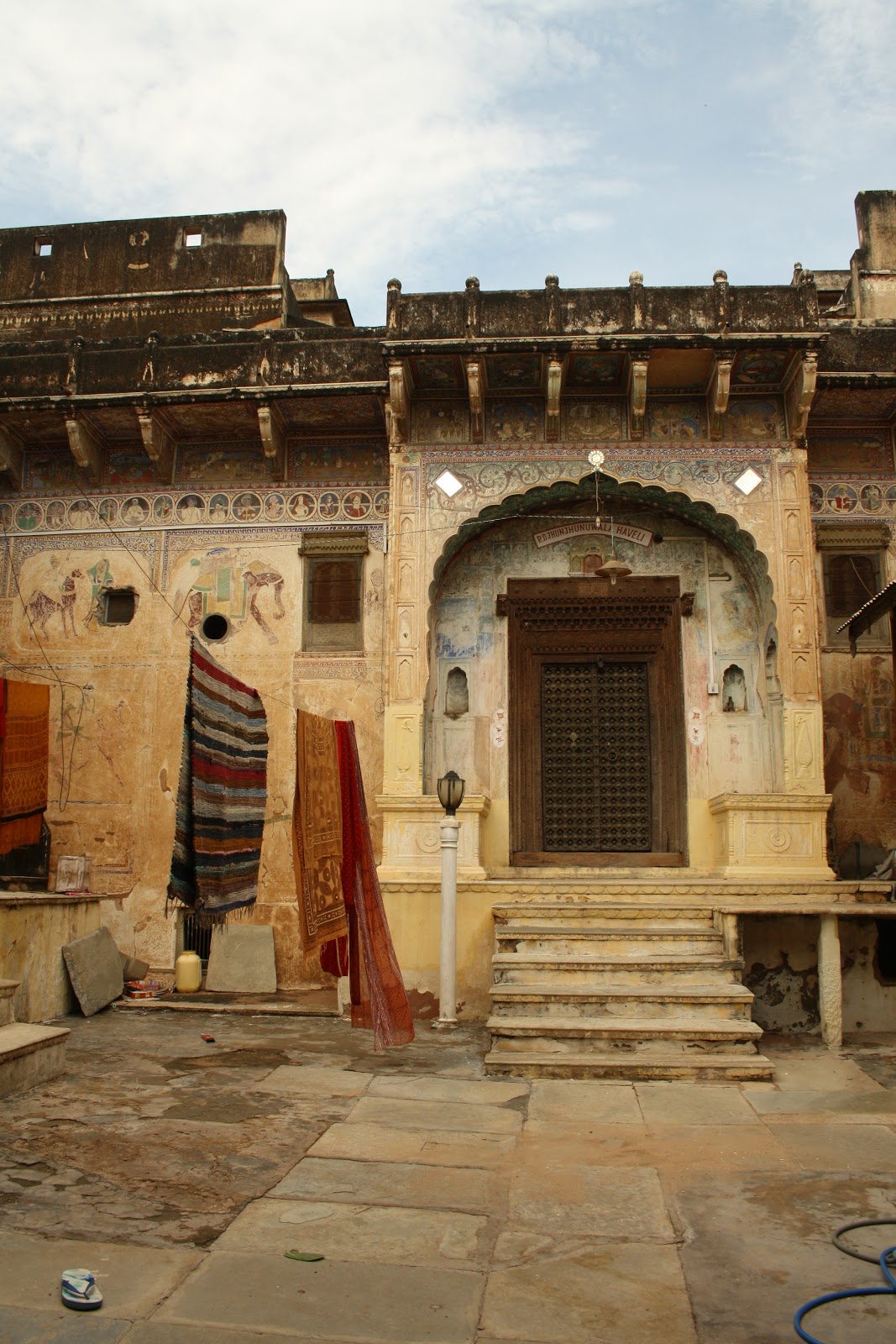
Inside the Jhunjhunwala haveli

Street Art


So what is a haveli?
When translated from Persian, ‘haveli’ means an ‘enclosed space’. It is in some ways, a south asian mansion. Havelis are typically 2-3 storeys with the higher storeys having balconies supported by carved and painted brackets. The windows on these balconies that are generally plain wooden panels hinged on the sides are conspicuous by their stark contrast to the decorated walls .The building is built around a rectangular courtyard which might have a fountain or a small artificial pond. The haveli contains several rooms with possibly certain areas especially for men or women. The walls outer and inner are frescoed and decorated. Some might even have antiques on display.

Vibrant colours of Rajasthan
Among the notable havellis are the Goenka double haveli, the Gulab Rai Ladia haveli, the Mohanlal Saraf Haveli, Murmuria haveli and others. There is also the Mandawa haveli now turned into a hotel. With their original owners moving to India’s metros over time, most of them are now looked after by caretakers employed by the original families. The havelis demonstrate a community’s desire to preserve their showcase of art; but unfortunately, this showcase is in a slow state of decripitation like many of India’s monuments. With paint peeling off and moss encroaching in from the corners, the liveliest thing you will find are the fluttering clothes on strings in the courtyard. But don’t get me wrong, even the frescos that are left intact are a feast for the eyes. Most themes revolve around Hindu mythology and royalty. Also apparent is the colonial influence, with paintings of Europeans and the advances they brought to the subcontinent. Renovations are on in most havelis and one hopes that the former elegance of these buildings is fully restored.
It is highly recommended that your see Mandawa on foot – it is small enough for you to cover the entire village in a few hours and it is worth every minute! Some of the best work on display is not inside the havelis, but outside. Murals and paintings will accompany as you walk through the village- street graffiti of a different kind!  Add to this, a touch of regular Rajasthan – the striking  colours of local attire against the sandstone coloured walls, the equally colourful and animated puppets on the corners and the calm, self coloured camel who doesn’t quite seem to bother if you exist or not – and you have a visual treat.

Looking out from Ganga Mai temple, Nawalgarh
Gaurd at Mandawa fort
I end the day at a handicraft store – on sale are bedsheets, pillow covers and paintings with exquisite Rajasthani work, but none of them say ‘Mandawa’. My attention turns to a particular painting – a very generic theme of an elephant in a procession, but the paper is different, something else seems to be written on it, and I mean handwritten! The shopkeeper tells me that it is used stamp paper. I notice the seal at the head. The shopkeeper, noticing my excitement pulls out a few more – the trend is the same – a lot of the writing has faded away, but you can tell that they are of the neighbouring provinces – Jeypore (Jaipur) or Kishangarh. What’s more, I got mine in a thousand bucks! It resembles for me the outlook of the locals – the indomitable innovative spirit that gave India some of her best businessmen and gave Shekhawati a new canvas.


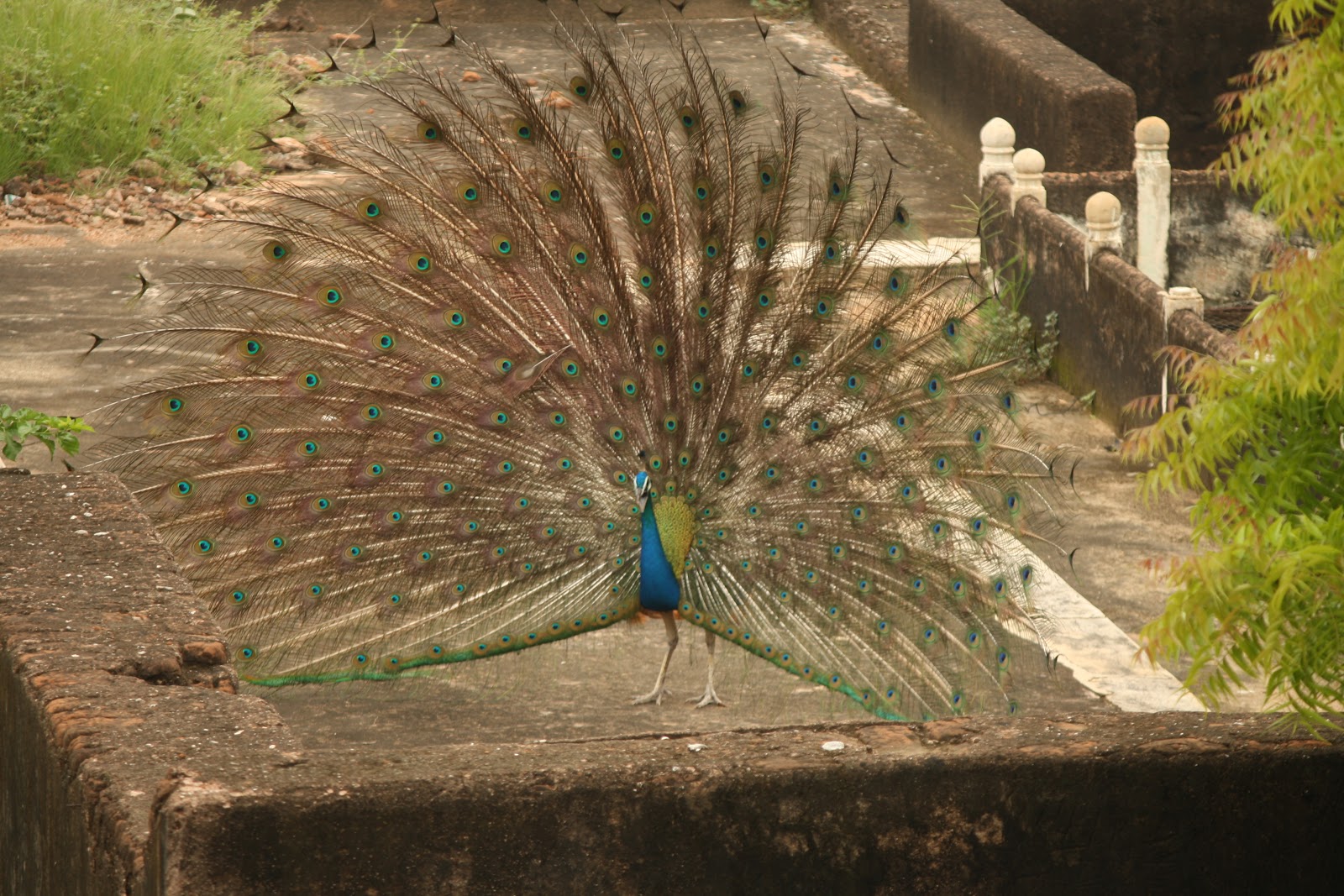
A peacock in Nawalgarh
Excursions from Mandawa
People often wonder about the best base to explore Shekhawati is – for me it’s easily Mandawa. Some of the other cities/towns in the region like Jhunjhunun, Nawalgarh and Sikar are crowded, dirty and more expensive. The exhibition continues but the homely and unadulterated feel is missing. Other village/towns worth a mention are Churu, Mukundgarh, Dundlod and Fatehpur.

Pointers


Lively puppets

Saturday, April 23, 2011

Ladakh - Photo tour


After a course at Photosensitive (http://www.photosensitiveworkshops.com/), I travelled to Ladakh on a photo-tour with photosensitive again. So I guess the most appropriate way to describe the experience would be through a photo post. More photos at http://photobucket.com/ladakh
Many Thanks to Joginder Singh and Shailan Parker for a great time and all the lessons on photography!

Leh

Nimu-the confluence of the Zanskar and the Indus


Pangong lake


Chemrey monastery

Ladakhi homes

Stakna monastery


Shanti stupa, Leh

Saturday, December 11, 2010

Puri


Pictures of Lord Jaganath and other items (including a mini Ashoka chakra) being sold near the Jaganath temple

Monday, October 25, 2010

Gurudongmar -Three's company


The engine refused to start! The driver relentlessly repeated the ignition sequence, but the sound of the engine died down each time and with it, our hopes of getting to Yumthang. Not only are our travel plans in jeopardy, but our safety – we are over 13,000 ft up, in the middle of nowhere. It is close to midday, but outside the vehicle, the rain assists the temperatures in plummeting to single digits. Worse still, the closest form of civilisation – the village of Thanggu – is about a half hours drive away. Our driver it seems has tried everything and is now beckoning us out of the car. I look around towards RM and JC. The anxious look on their faces expresses a similar disappointment.
Lachen to Gurudongmar lake

Ice breakers on the road
RM and JC have been acquaintances of mine for about 40 hours. They on the other hand have been friends since school. Our decision to travel through north Sikkim together mimicked an effort of coalition politics rather than a happenstance meeting of friendly, similar minded beings. A trip to Gurudongmar and Yumthang valley was proving to be too expensive for either of us, separately. But lady luck was on our side that evening, and all three of us stepped into the travel agent’s office on MG Marg, Gangtok at approximately the same time, making the suggestion a no-brainer for the travel agent.  It was weird, that first meeting, each one trying to figure the other out - like two dogs introduced to each other by their owner – sniffing each other for any signs of danger– the accent, attire, unnecessary body marks. But the foremost fear in my mind was whether or not these guys were really travellers! Will they keep puking out the car window throughout the journey? Would they buckle under the heights of Gurudongmar? Will they expect a better hotel at Lachen and cry foul? But as always, the predominant urge to travel allowed me look beyond all possible shortcomings.
Our conversations in the Maxx, the next day were limited to small talk – our work, education, families. None wanted to make any bold comments or suggestions. Inevitably, though as it would seem, conversations drifted onto travel itself. A few weeks before, the duo had travelled to Lava which is about 30-odd kms from Kalimpong in North Bengal. The excitement in their narration of the events was apparent. And as they described, with an air of wonder and devotion, the glimpse they caught of Mt. Kangchendzonga through the clouds, I laid to rest my fears of my companions. They certainly weren’t just dreamers.  I, in turn, having been to Kalimpong and Pedong earlier in the year eagerly exchanged notes with them. It was now their fears that were to be allayed with tales of pursuit of a lost Bhutanese fort (which I never reached, by the way), the leeches, the clouds and all things hidden in the forgotten hills that would gladden a wanderer’s heart.

Lachen (“Big Pass”)
The village of Lachen
The ice was now broken! In the assurance that none of us would by inclinations or frailty endanger the journey, the chronicles of our ramblings and experiences unfolded – from Kolkata to the North-east to the nation’s capital and my home city of Bombay (Mumbai). Anecdotes that took us past the dusty district capital of Mangan , the beautiful and meandering Teesta, the reticent village of Chungthang at the confluence of the Lachen and Lachung and finally into the village of Lachen just after dusk.
Lachen was oddly comforting – beating my expectations, there were double and triple storeyed houses and hotels, with satellite dishes protruding from the sides giving you that feeling of being connected to the world you have left behind. Darkness however kept from me, her bountiful surroundings – of green wooded slopes, with patches of autumn yellow, of stealth clouds and the silent but ever moving Lachen river. In any case, exploration of the town was to be deferred – not only because of the curbs of caliginosity, but also the requirements of the next day. Vehicles are not allowed to the lake after 12 noon as the conditions then deteriorate and make the place inhospitable. An early dinner and early start in the morning was due.

Gurudongmar-water on the moon
Thanggu


An Army run cafe on the way- apparently the world's highest!

The drive from Lachen began before sunrise at around 4:30 in the morning. The landscape around that was sparsely peppered with fields and single houses, appeared in shades of grey under the awaited sun. Only the tops of the mountains, usually the first to feel her warmth, could be seen albeit through filters of orange. We made an early stop at the village of Thanggu, where we are guided into a local home for breakfast – bread with hot, molten butter poured over it, to be eaten hot before it froze back again.
Yak herder's hut
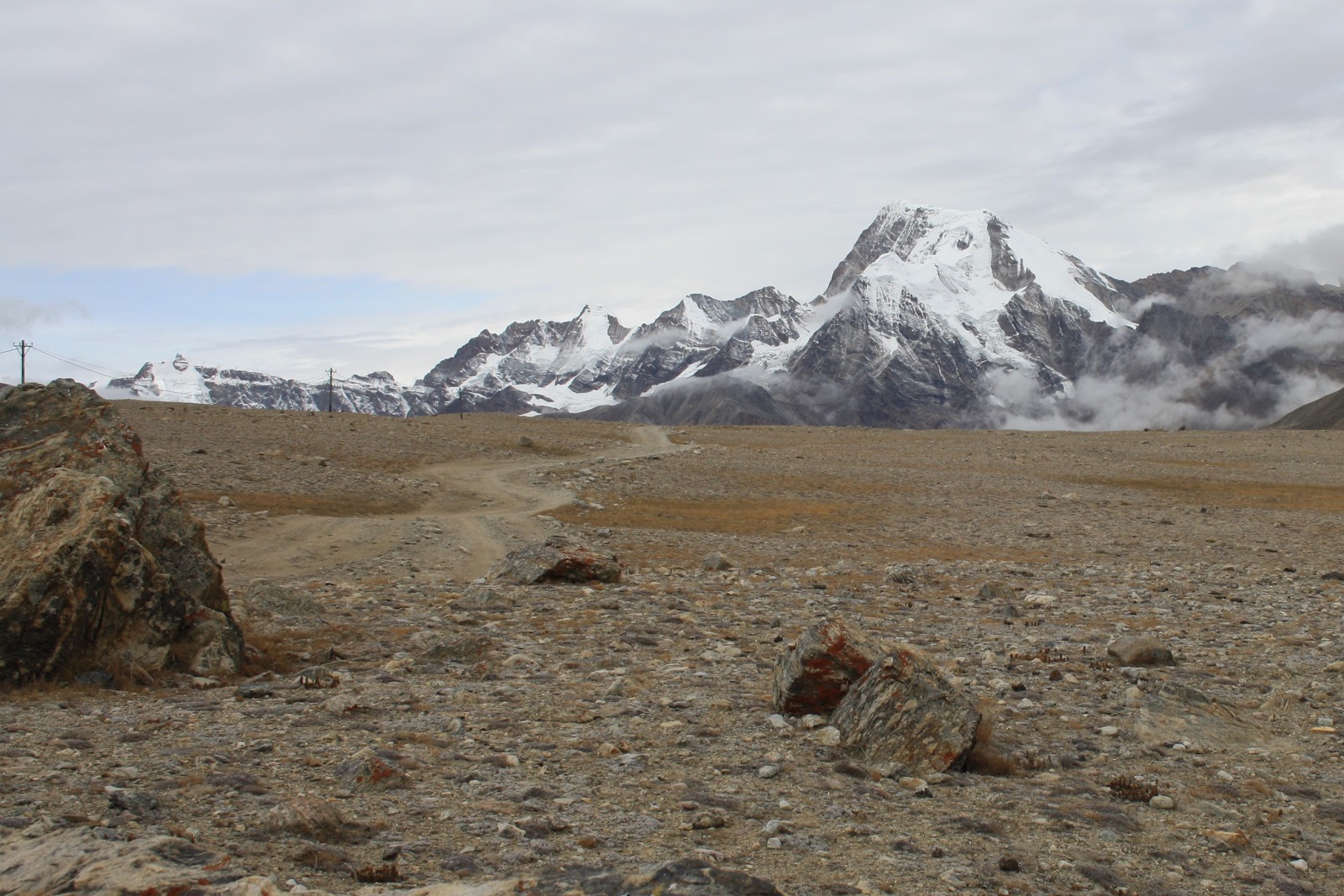
Thanggu is at 14,000 ft and after the village the tree line recedes to give way to the vast desert plateau.  It’s a concoction of comatose gravel and stone stretching across acres, with the icy mountain ranges on the sides, standing tall and firm like organised battalions. If only a herd of horses were to gallop across the vast space, with purpose and freedom, so that movement, life and sound may render this portrait complete! But alas, the only four legged animal you are likely to spot is the Yak. You will find them grazing on the patches of grass that miraculously found a way to survive here or near the herders’ huts – crude stone structures with attached enclosures.
The lonely, desolate road to Gurudongmar
Back in the Maxx, RM’s head was tilted back. He was trying to sleep off the mountain sickness that has gripped him. Later, at lower altitudes, he spoke of the flashes of tragic events and nightmares that he experienced during his sleep – the oxygen levels must have really been low.  
When we arrived at the lake, a few moments later, it was similar to desert voyagers sighting an oasis. Gurudongmar lake might have gallons of water, but it’s not bodily thirst that one quenches here. Her demeanour is more spiritual - the placid waters, the remoteness of the mountains, the strings of prayer flags that adorn her banks and of course the Sarva Dharma Sthal (House of worship for all religions) is a good representation of her past.


Gods of the lake
Gurudongmar lake gets its name from Guru Padmasambhava (Guru Rinpoche). Sikhs believe that Guru Nanak (also known as Guru Dongmar)was known as guru Rinpoche to the Tibetans. Either way, both are believed to have passed through these parts.
(http://www.east-himalaya.com/sikkim/gurudongmar.html, http://www.sikhiwiki.org/index.php/Gurudongmar_Lake)

Gurudongmar Lake

Tibetan prayer flags add to the spiritual ambience

There isn’t much to do around here, except for soaking in the tranquillity and taking wonderful pictures. After we are through with that, we scampered to the Maxx for a quick return to Lachen and then onward to Lachung and Yumthang. But, now about two hours later, we are huffing and puffing as we try to push the Maxx into life – she doesn’t. We spot an army post up ahead and request some engineers to have a look.  The fuel filter is detected as the culprit – it must be the fuel that was bought from the makeshift station right after Gangtok. In desperation, the filter is removed, but the Maxx still refuses to co-operate. There is now no hope of getting to Yumthang.

Rescue
Finally, after options are knocked off, the army generously offers us a ride to Lachen. A truck would be crossing the village en route to another post and we are offered a lift. It’s an interesting turn of events, a chance to ride with our armed forces in one their vehicles, even though it’s as peaceful a mission possible. As we clamber into the back, one of the jawans yells to us with a smirk, “You will remember this ride for the rest of your life!” as he gets behind the wheel.
The ride is as rough as it gets – we find ourselves tumbling from one end of the truck to the other, first in shock and then with playful frolic as with a roller coaster. Outside, humans are still scarce, but life as we know begins show up in patches of green, yellow and orange amidst the conifers. The lichen and rhododendrons sprinkle more colour on the canvas. These are the vistas that I lost in the morning, partly to the darkness, partly to my reclamation of sleep. We are closing in on Lachen. I suddenly realise that our travelling group is now four – in the corner, is the driver of the Maxx, anxious as ever. He needs to find a mechanic from somewhere and take him to the point where we left the vehicle. He is looking at severe losses of repair, time and opportunity. I wonder if he has any travel stories –perhaps now is not the right time.


Pointers

  •      Whether Indian or foreigner, you will be travelling close to India’s borders and you require a permit to cross Mangan. These permits can be attained from recognised travel agents which can be found in plenty on MG Marg, Gangtok. However, no agent is willing to just deal in permits – you will have to make all arrangements of travel through them.
  •      You will identity proofs and photographs of yourself for the same. Foreigners should carry their passports.

Saturday, September 4, 2010

North Bengal

Football match at Pedong

Pipe organ an St. Theresa's Church, Kalimpong

Ghum, the highest railway station in India

Darjeeling Himalayan Railway ("Toy train") at Batasia loop, Darjeeling

The fight for gorkhaland goes on! (pic taken in Kurseong)

Tea plantations in Kurseong