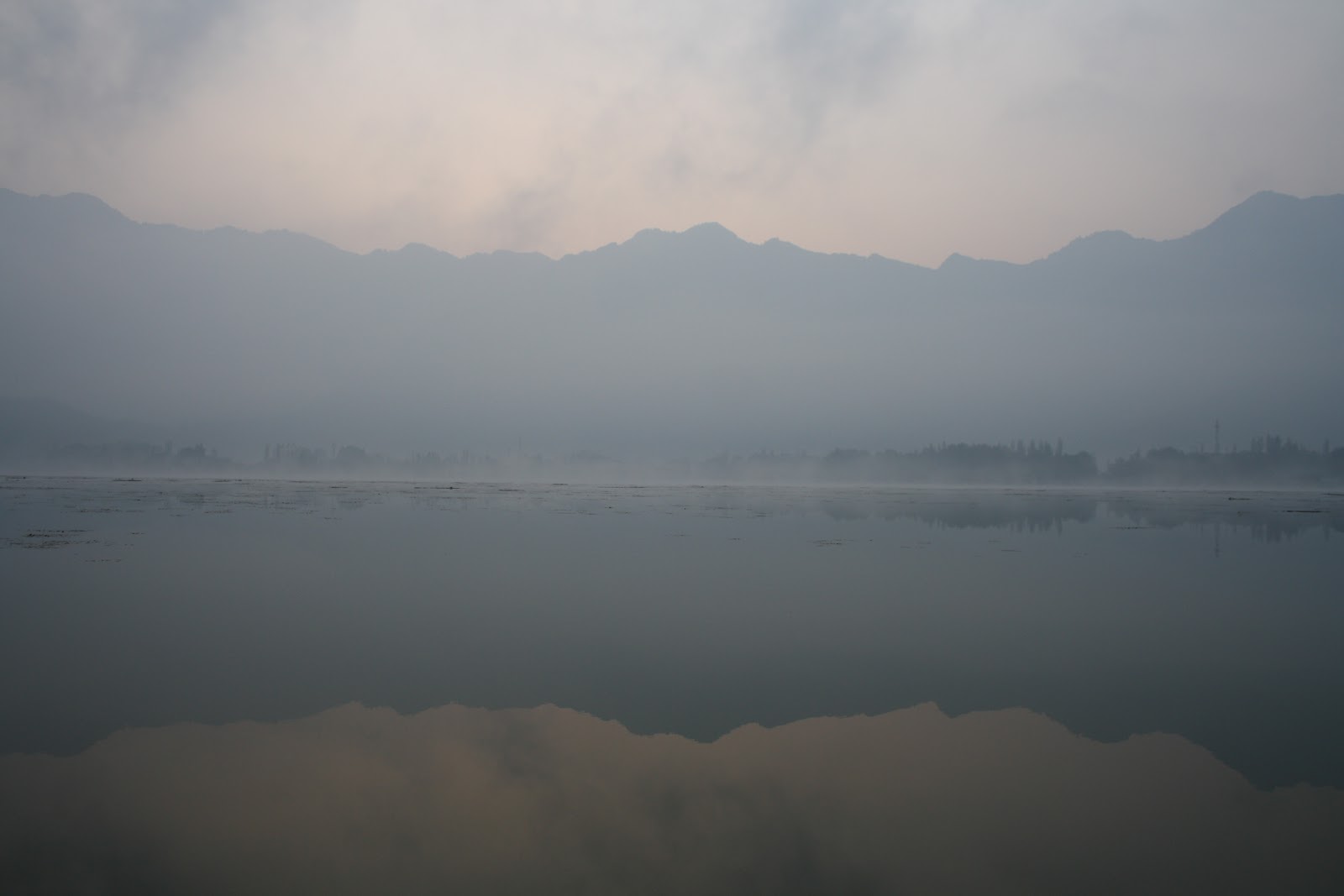
It’s simply water in its solid form. We add it to our scotch,
we devise sports around it but we take it for granted! Ice, in its natural form
creates some the world’s most amazing landscapes – white crowns for towering
mountains, complete biospheres near the poles and glaciers that sculpt out
valleys or perhaps fjords. Here in Kashmir and Ladakh it creates nothing short
of the same. It’s easy to sight white mountain crests in the Himalayan North,
but not really glaciers. The slow icy rivers are easily the most reticent of
landforms – they stay aloof, slowly navigating the higher, inhospitable regions
of Himalayas. It’s a privilege to see one, an adventure to get to one and I am
on my way to the Darang-Durung glacier in the heart of western Ladakh.
A Kashmiri autumn
Srinagar brings to mind gory and horrific images of bomb
blasts and terrorism. But, the Srinagar we arrive to is peaceful - hazy and
overcast, but calm.
+Salil Malik (my batch mate and friend) and my spirits are raised
when we get a vehicle to Kargil within the hour. Our driver, Muhammad Ali, is
soft spoken and courteous unlike his namesake. His name might suggest a more
Muslim, perhaps Kashmiri lineage, but the features are definitely Tibetan-mongoloid.
He is quite at home conversing in Urdu, but the accent again is more eastern. We
take a short detour at Ganderbal since the road is blocked by a
hartaal and make our first stop at
Kangan - my first opportunity to bite into local cuisine. It’s simple – a sort
of pattice without any filling which is a
Kashmiri
Kulcha (Thanks
+Tiksha Kaul for this clarification) and some
noon chai (salt tea) – a
pink coloured tea that is prepared with pistas and cardamom.
 |
Breakfast at Kangan - Kashmiri Kulcha with Noon chai (right).
Regular tea on the left |
The drive to towards Kargil continues. It’s now October and
autumn has arrived in the Kashmir valley. The greens of the valley are
gradually being replaced by the yellows and oranges of the season and the air
has a whiff of winter. At Sonamarg, we pass the opportunity to see the Thajiwas
glacier. It is a few kms from Sonamarg, and we want to get to Kargil before
sunset. Besides, it’s very accessible and a little too touristy for our liking.
A few frames of horses grazing in the meadows will do for now.
 |
| Horses in the meadows of Sonamarg |
Before we get to Drass and Kargil, we must cross the Zoji La
(3,528m). The skies have been overcast since Srinagar and we are expecting a
rough time. Half way up to the pass and we are hit by sheets of snow. The
experience is enthralling and intimidating at the same time – our vision is
reduced to a few meters – we can just see the truck ahead. A quick glance down and
I can barely see the edge of the road; leave aside the bottom of the valley.
But MA is seasoned and navigates the Scorpio well through the frost and snow
and past Zojila. The autumn colours continue on the other side of the pass, but
are sparse – Ladakh beckons!
 |
| Crossing the Zojila |
The War memorial –
Drass & Kargil
The
Kargil war fought between India and Pakistan in the summer of 1999. In the
preceding winter, Pakistani troops and mercenaries took positions on the Indian
side of the Line of Control as the Indian army abandoned the positions due to
the harsh winter (a normal practice at this time). The incursions set off a
military confrontation between the Pakistani backed forces and the Indian Army.
Fighting ceased on the 26th of July – India managed to push back the
insurgents. (http://www.newworldencyclopedia.org/entry/Kargil_War)
Some would describe the state of Jammu & Kashmir as a
‘paradise’, but it is also a region torn apart by conflict with some western
parts controlled by Pakistan and some eastern ones by China. It’s a region
where ‘glacier’ is almost synonymous with the one of the highest battlegrounds
in the world – Siachen.
 |
| Tin domed mosque at Drass |
Drass has seen its fair share of war, but I don’t see the
scars – no poverty, mistrust of foreigners etc. Life it seems is back to normal
in the coldest place in India. But, I do see plenty of memorials in and around
the town dedicated to the Indian soldiers who gave their lives for their
country. We reach Drass in time for lunch. The locals are said to be of Dard ethnicity
and Sunni Muslim (1), but I am not good enough to validate the
first. The bazaar still looks a lot like the ones we crossed on the way – a
line of restaurants with long bearded men hanging around – they either wear
sweaters, coats or a local ‘pheran’. All the restaurants claim to serve wazwan, but once you get in, it’s just
the good ol’ chicken biryani that is available – perhaps it’s because this is
the off-season. But there are three things that did catch my eye – the amazing
view of Tiger Hill from the bazaar, the tin domed mosque - Tin or asbestos is
often used for the top of the mosque in these parts but it’s the first I have come
across – and that the houses have started to flatten down into single storey
cubical structures with flat roofs.
 |
| Local in Drass in a 'pheran' |
The wide fields of Drass start to compress once again into
the mountainous rocky road at Bimbat. At Channigund, near an Army post, a board
reminds us of our proximity to the Line of control – it reads “Caution. You are
being watched.” The LOC is across the river and we are truly being observed. Regardless
of the signs, the memorials and bunkers on the way to Kargil are enough to let
you know how close you are to the enemy. I come from a city that has seen
plenty of terrorist activity, but I have never been this close to the devil
himself!
 |
| Autumn in the valley (our Scorpio on the right) |
Kargil is a pleasant surprise - it’s not just a big
town, but a thriving one. On the banks of the Suru river and amidst an arid
landscape, it boasts of most of the amenities of a modern town – ATMs, good
hotels, transport options, decent internet connectivity, an active market etc. After
checking into Hotel Siachen, we stroll about in the main market. Again, my
tongue needs a taste of the local food – I spot a few street vendors selling a small
sausage like preparation. The locals tell me that they are goat intestines. They
are fried and served with a spicy red sauce and chopped onions and for Rs. 2 apiece,
they are a MUST try. However, they are rather heavy and spongy (as compared to
a chicken sausage), and I am struggling to get past half a dozen.
Suru Valley – the
metamorphosis
 |
| More autumn frames.... |
It’s an early start the next morning from Kargil. Many
travelers start even earlier to capture the sunrise over the Nun & Kun
peaks, but we prefer to watch the valley unfold before us in the day – and we
are well rewarded. Kargil was a melting pot of ethnicities, religions and
cultures – sure, it was a big town. But here in the valley, it’s a slow change,
of terrain, of vegetation and of religion. Speeding out of Kargil, we pass her
suburbs and get to Trespone to see the grand Imambara. It is still early
morning and the Imambara is closed, but a place beyond her walls is good enough
for admiration. It’s then on to Sankoo for breakfast, followed by
Panikhar. Autumn continues to sprinkle
her colours by the way, albeit in smaller portions, but the land is distinctly
Muslim. The tin domed Mosques are now in greater numbers.
 |
| Parkachik Glacier |
Bearded men with Taqiyahs
and women with scarves loiter around by the fields that turn a lush green in
the summers – watered of course by the Suru River. Flat mud houses lay squat in
clusters surrounded by fields and short trees with black billed magpies darting
and tweeting all around. Now and then, you will get glimpses of Nun peak, the
highest in the state, that’s ofcourse if you know which peak is Mt. Nun.
Unfortunately, even the locals seemed baffled when you ask them about it and
keep pointing in different directions.
Parkachik marks a change of terrain, vegetation and people.
It is the transition point of Suru valley. Chortens indicate a switchover to
Buddhist settlements around. The mud houses continue in spurts but the valley
empties out – a vast expanse of lifeless land, with just the river for company.
Parkachik is also where we see our first glacier –the Parkachik Glacier– a
rather small mass of frost clinging to the mountain side. It is close enough
for you to cross over and get up close. A little further ahead, we catch our
first glimpse of the Rangdum monastery – a red structure atop a small hill with
mountains standing guard.
 |
| Kids in the family that hosted us |
 |
| The expanse beyond Parkachik - Rangdum monastery in the distance |
We halt at Rangdum and take a room with a family. MA talks
to the family in another language now, one that sounds similar to Tibetan – the
language has also changed apparently. But there is bad news on the horizon.
Beyond the monastery, we see clouds sweeping into the valley. The bad weather
seems to like playing hide and seek with us. Within minutes, Rangdum is covered
in snow. The family tells us that it’s the first of the season – we seem to be
lucky yet unlucky! The snowfall continues for the next 3-4 hours. After an initial
frolic in the snow, we get back to our room to contemplate our fortunes. If the
snow continues, Pensi la and Darang Durung glacier will be inaccessible! Sleep
it seems can counter our disappointment and we hit the sack earlier than
normal.
 |
| Making Noon chai at the homestay |
 |
| Yaks return to the village after the first snowfall |
 |
| Our homestay |
 |
| Rangdum monastery |
Winter wonderland
 |
| The senior monk |
 |
| Prayer hall in Rangdum monastery |
The next morning brings blue skies and the hope that we can
get to Pensi la. First up, we make a pit stop at the Rangdum monastery. The
monastery, a good 5 kms from the town, is perched on a hill with the river
weaving past its sides. It’s the beauty
of isolation – Shangri-La you say? Well, a strong contender I’m sure. The
monastery looks deserted, but a monk soon comes out to show us around. He even
invites us in for tea and snacks with the other monks. One of them is
noticeably senior – partly because, well, he looks old and perhaps partly
because his head gear resembles that of a Catholic Cardinal! It's a traditional hat in Ladakh and you can find many monks wearing it. He asks us why we
would venture out here to Rangdum at this time of the year. “It’s so cold!” he
says. We tell him that we are on our way to see the Glacier. “It will be still
colder there!”, he retorts. The climb to Pensi La continues. It’s October, but
it feels like spring – the Sun is out and the frost on the ground is thawing.
We ascend past the 4,000m mark to discover a series of glaciers – each defrosting
into a tributary of the Suru. The Scorpio slips and slides on the ice as MA
negotiates the bends and the frost and then finally we are there – a little
after Pensi La, the demarcation of the Suru and Zanskar valleys, laid the
Darang-Durung glacier. It’s white all around – the terrain around us, the
mountains opposite us and of course the glacier. You need to see the crevasses
on the surface to outline the glacier and once you have that figured out; it
really is a sight to behold. It is as Kenny Rogers and Dolly Parton would
describe it – ‘a winter wonderland’ and I have got my Christmas gift 2 months
early!
 |
| Rangdum Village (taken on the way back from PensiLa) with Mt. Kun in the background |
 |
| Darang Durung Glacier |
It’s funny this little journey of ours, we set out to
discover glaciers and at each juncture were pushed back by snow and ice itself.
Come to think of it, they weren’t impediments; they just completed the chase
for Ice!
POINTERS
- Kargil has a strong taxi union, if you hire a taxi from
Srinagar/Leh, you might have trouble taking it into Suru. (We had to rehire MA
at Kargil!)
- Rangdum is an excellent site for star trails – make sure you
have enough batteries
- Home stays are common in Ladakh and are extremely
comfortable
References
1. ‘Ladakh’- Partha S banerjee




 The colour and contrasts continue into Fontainhas. I also begin to
notice the hand painted name plaques for roads and houses. White backgrounds
with blue decorated borders seem to be the most common but not the norm. The
plaque generally holds the name of the family or street prefixed with a ‘Casa’
or ‘Rua’. But I am more interested in the pronunciation of ‘fontainhas’. I keep
saying “fôntīnäs” till finally when asking an elderly man for directions; he
replies “fôntānyäs” firmly. I repeat the same, and he nods his head with
approval and says, “It’s Portuguese!” with pride. Meanwhile, still within a
earshot, as I walk away, I hear a woman mumbling something to which the
gentlemen replies, “Ah! turistas..” with
an air of dissent as if I were the hundredth person he corrected that day. But don’t
be misled by that incident. The people are very friendly and are more than
happy to correct your pronunciation, engage you in chit-chat and share their
version of Goan heritage with you. I walk upto the spring or fountain from
where the place gets its name and then turn back and left over Emidio Gracia
road towards the church square (earlier known as ‘Largo da Igreja’) which is
home to the famous Church of our Lady of Immaculate Conception.
The colour and contrasts continue into Fontainhas. I also begin to
notice the hand painted name plaques for roads and houses. White backgrounds
with blue decorated borders seem to be the most common but not the norm. The
plaque generally holds the name of the family or street prefixed with a ‘Casa’
or ‘Rua’. But I am more interested in the pronunciation of ‘fontainhas’. I keep
saying “fôntīnäs” till finally when asking an elderly man for directions; he
replies “fôntānyäs” firmly. I repeat the same, and he nods his head with
approval and says, “It’s Portuguese!” with pride. Meanwhile, still within a
earshot, as I walk away, I hear a woman mumbling something to which the
gentlemen replies, “Ah! turistas..” with
an air of dissent as if I were the hundredth person he corrected that day. But don’t
be misled by that incident. The people are very friendly and are more than
happy to correct your pronunciation, engage you in chit-chat and share their
version of Goan heritage with you. I walk upto the spring or fountain from
where the place gets its name and then turn back and left over Emidio Gracia
road towards the church square (earlier known as ‘Largo da Igreja’) which is
home to the famous Church of our Lady of Immaculate Conception.