This blog contains accounts of my travels in India and abroad. Some of the posts were created much later, the dates have been adjusted to give a sense of the real time.

Saturday, October 28, 2017

Vietnam: Order within chaos


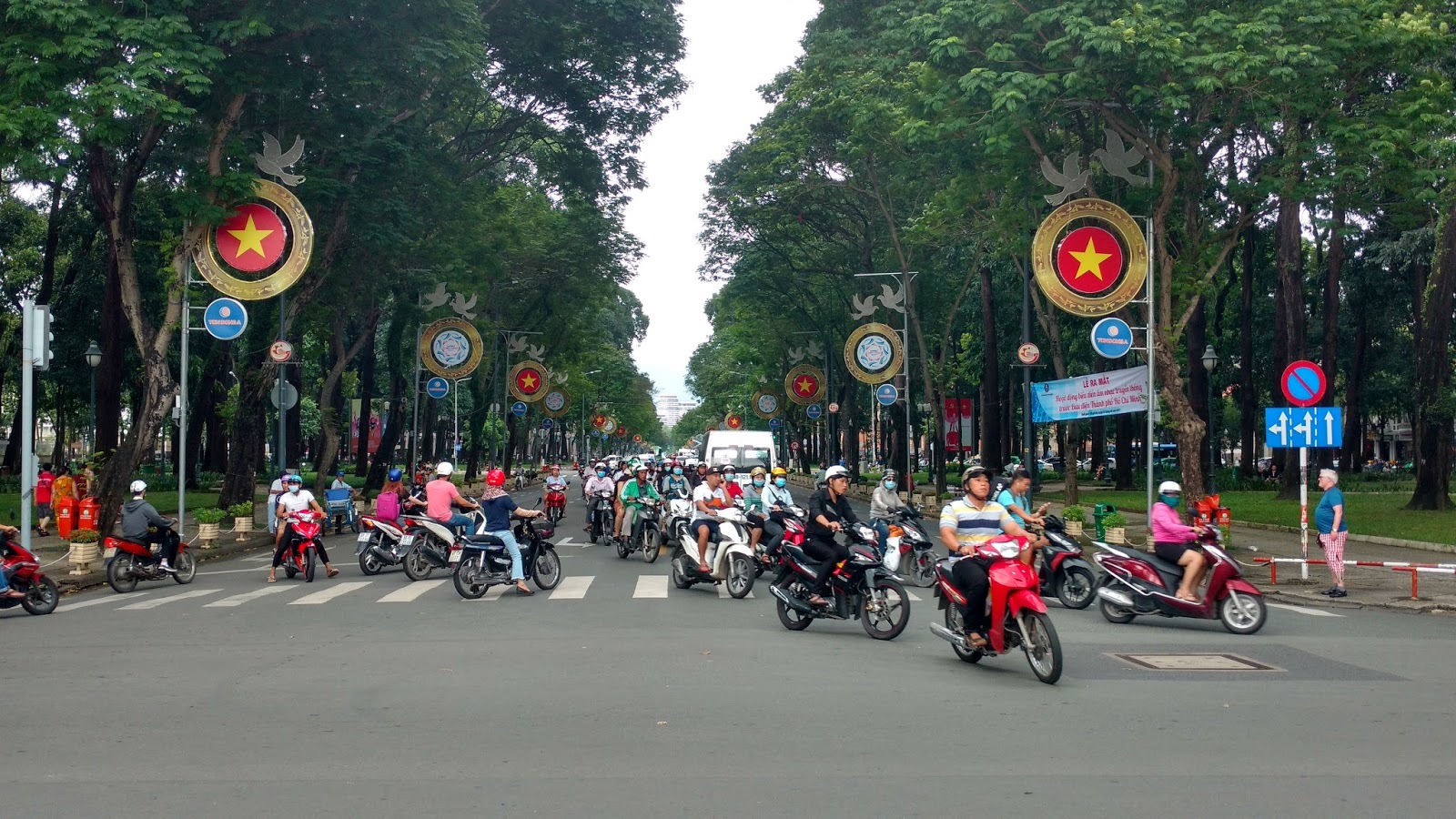
2 wheelers in Vietnam
There is no dearth of 2-wheelers in Vietnam       [@Saigon]

Trang An
But, there is silence to be found in the villages...    [@Trang An]

Bai tu long bay
.....and on the high seas       [@Bai tu long bay]

Hanoi
Tradition and modernity jostle for space on her roads       [@Hanoi]

Tai Chi in Hanoi
At times it can co-exist       [tai-chi @ Hoan Kiem lake]

Cyclo in Hanoi
I sincerely hope that tradition isn't left behind     [@Hanoi]

Walking street, Hanoi
For now it lives on...    [@walking street, Hanoi]

Cà phê trúng trails


I must confess, I’m not particularly a coffee person - just one cup every morning for a spurt of energy to take me past a day of chores. But, the prospect of having egg coffee in Vietnam got me quite excited – as all things local & traditional do.
It was one of the first things (along with Pho) that I had asked for in restaurants in Saigon. I got enough and more Pho, not so lucky with the coffee. As I was to learn, most Vietnamese prefer their coffee bitter and black. For white, they add condensed milk. At cafes, the coffee would be served without sugar, and no matter how much sugar I added, it was never sweet enough!! Furthermore, in the South, I sensed a clear preference for cold coffee as well – to the extent that, if not clearly mentioned at a cafe, the default coffee served would be COLD. Later, during the Cu Chi tunnels tour, our guide, Hang, tells us that getting egg coffee in Saigon would be difficult, “Egg coffee is amazing, but you only get it in Hanoi. Not sure why, but maybe it is because of the cooler climate there”.
So be it! The wait continues....
When we landed in Hanoi a few days later, we immediately hit the Thuy Ta cafe which sits on the North bank of the Hoan Kiem lake. It made for a wonderful evening, looking out at the lake. But, my hopes were dashed - they didn’t serve what I needed. However, on the way to the lake, I had noticed a cafe, ‘The Note coffee’, that had a board outside saying that they served Egg coffee. I made a mental note of it for later. My disappointment extended to next morning when there was no egg coffee for breakfast at the hotel as well. Our guide to Trang An, Long, later explained, “Egg coffee is just for tourists. Locals have black coffee. It is made with raw egg yolk, so people get a bad stomach”.  Another case of diminishing tradition? Perhaps, but my hopes weren’t diminished yet!
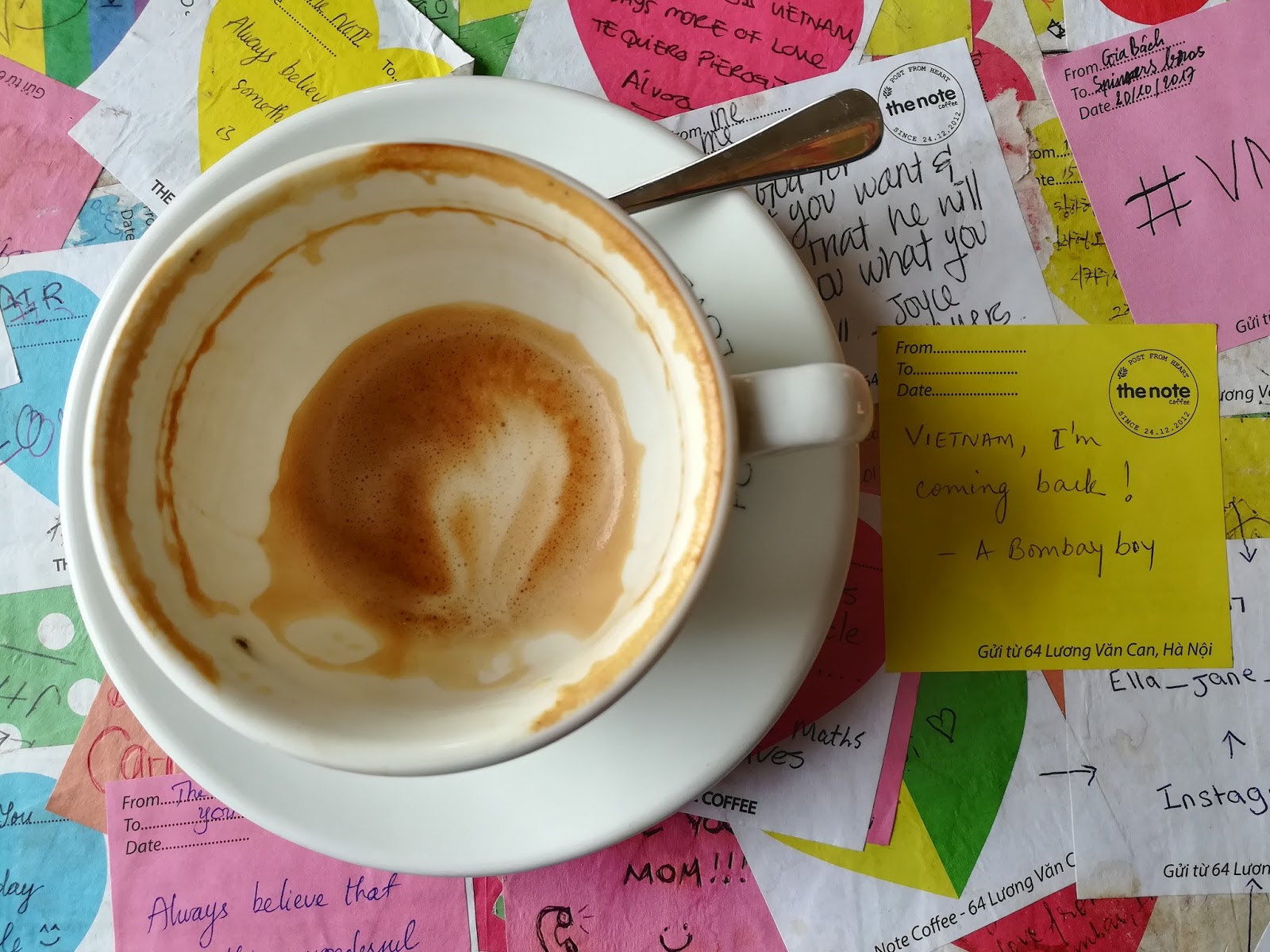
Next morning, I headed to the Note Coffee. Opposite the Thuy Ta, this cafe was narrow but lifted a few storeys above, so it gives its customers a good view of the lake and street around it. But, before I could finally enjoy some Ca phe trung, I found myself lost in the decor of the cafe – Notes, from customers, posted all over - on chairs, walls, tables, everywhere. It certainly made for an interesting read. That was cut short though, as <trumpet blast> my coffee had arrived – with a little note J
But it didn’t seem like anything I read in the reviews – it wasn’t creamy, it wasn’t thick, it tasted like the coffee I got back home. When talking to the waiter I realise that there was no egg yolk and less condensed milk. The search continued...

Inside the Note Coffee Cafe
My coffee, with a note :)


So, I left behind a note as well

With one day left in Hanoi & Vietnam, I had to switch from explorer/traveller mode to Google search mode. Not proud of it, but it had to be done.
Top of the recommendations was Giang cafe on the eastern edge of the old quarters. It took some time finding the place, primarily because the entrance is really small & narrow. I go upstairs to find the tables and chairs overturned – I was in too early. The owner walks in and turns on the lights to reveal a dusty, small room with old paint clinging to its walls and even older paintings hung above- surely this is the place! The coffee was placed on my table 10 mins later. The two layers of the coffee were visible through the transparent mug that was in turn placed in warm water (to keep the coffee warm). It was thick, creamy and tasted like tiramisu. I had finally found my Cà phê trúng and the search was worth it!
The real deal!

Inside Giang's

Don't miss the entrance

Later that evening, I tried another from the Google list – Cafe Pho co on Hang Gai. The coffee wasn’t as good as Giang’s, but the view was unmatched. You have to enter the cafe though a silk shop on Hang Gai and climb 3 floors to a rooftop where you get an amazing view of Hoan Kiem lake.
@cafe pho co

Breathtaking view from the top

And if you are wondering what happens to your stomach after 2 cups of egg coffee in a day – well, nothing. I guess Mr. Long was wrong.


Buying Coffee in Vietnam
  • Around Hoan Kiem & in the old quarters, you will find plenty of coffee shops selling Local coffee and weasel coffee
  • I finally bought Huongmai coffee in Hanoi which was a bit expensive (360k VND for 250g, about thrice the cost of other brands), but most reviews said that it was the real deal
  • In Saigon, our guide, Hang (from water buffalo tours - http://waterbuffalotours.com), had recommended going to the Phuc Long cafe at 63 Mac Thi Buoi. They grind the beans fresh here. Unfortunately, I didn’t get time in Saigon to pick up any
  • If you are interested in buying the filter as well, they are available for as little as 15k VND in the markets


Thursday, November 10, 2016

The islands of Venice

The vaporetto line 1 along the grand canal is scenic but long 
The Grand canal

The Grand canal 
San Giorgio island from San Marco

San Marco from the San Giorgio campanile
View from the San Giorgio Maggiore campanile - in the foreground is the church and in the background the Salute church
The colours of Burano

Burano Lace

View from the Campanile of Santa Maria Assunta Basillica at Torcello

Glass making at Murano

Finished samples, Murano

Saturday, November 5, 2016

Timeless Pizza!

I often tell people that I was introduced to Pizza by Michelangelo and Raphael. No, not the artists, the Ninja Turtles! Yes, growing up, our ‘heroes in a half shell’ were the latest crime fighting stars and pizza became the coolest food of the day! You won’t catch me narrating my early encounters with pizza to the Italians though. They take their art and food very seriously, and my statement would be nothing short of blasphemy!

But, my pizza experiences were limited largely to the Indian subcontinent, where the food is more commercial. So I was looking forward to the tasting the real stuff in Italy. My first journey took me to Naples – about 225 kms from Rome. It was a tour to Pompeii with City Wonders (https://citywonders.com/) that included a hike to Mt. Vesuvius and pizza at Naples.
Naples is the home of Pizza – at least the modern version, or so I’m told. If you think Italy’s history manifests in just stone buildings, you are in for a surprise. Pizza has its own history and it unfolds here in Naples.

The flatbread isn’t an Italian creation. It was consumed across the Mediterranean and Asia in different forms and was often eaten with different toppings. In the 1700s, Naples supported a large number of working poor (“Lazzaroni”) who found Pizza convenient – cheap and easy to consume. 
The Marinara and the Margherita are considered to be the ‘classics’. The first, is older and is named after ‘la marinara’ or the seaman’s wife who would prepare this food for husband when he returned from the Bay of Naples. The second has a more interesting story. After Italy’s unification in 1861, King Umberto I and his Queen visited Naples in 1889. The royal couple wanted to sample the local fare which of course consisted of Pizza. But there was a special variant that the Queen enjoyed – it resembled the Italian tri-colour with Basil, mozzarella and tomato. This was the first Margherita pizza, named after who else but the Queen, Margherita. The queen’s liking of a poor man’s food probably triggered the wide adoption of the food across the country which spilled over to other parts of the world when the Italians migrated.

Keep it rolling
The tour takes us to a restaurant in Naples for an original ‘Napoletana’. It’s fluffy and soft as compared to the ones in Rome which are thinner and have a crusty edge. As I sunk my teeth into a bit of history, I couldn’t help but compare the soft bread and the elastic mozzarella to the tandoori chicken pizza I got back home, or worse still, some chilli paneer version of it!

Next stop was a cooking class in Rome with InRome cooking (http://www.inromecooking.com/). Chef Max who is from Sicily quickly tells us the difference between Roman and Neapolitan pizza – similar to what I had heard on the tour 2 days earlier. But, we weren’t here for tales of Pizza’s history – we had to make our own Pizza. Max quickly gets into the method of making the perfect dough and somehow I wasn’t surprised to learn that a key part of the process was the time you leave the dough to rest – good things in life take time right! Longer the time, the lighter is the base. We add the tomato sauce and the toppings, shove it into an oven for about 5 mins and out comes a Pizza!

How in the world did this become a fast food – centuries to mature and at least a day to make!

The output
References:

Sunday, November 22, 2015

Kabini - The call of the wild


This wasn’t meant to be a drive through a forest and see Tiger pugmarks. Unlike my previous experiences with wildlife, Kabini promised the real thing, an immersion into the animal kingdom, a call to the wild! So when, I saw a Tiger’s stripes pass stealthily behind the grass on my first safari, it reconfirmed my notions about the place. Unfortunately, that was it for the big cats – there were alarm calls, rushes to spots of sightings, but the felines remained elusive. It was surprisingly, a bunch of wiry little canines that gave me the wildlife experience. Wild dogs, who individually look ever so innocuous, are actually as a pack the best hunters in the jungle with a strike rate of 8/10, as I am later told by Vincent, the naturalist at the Bison. Well it wasn’t really a hunt like I wished - just the pack pushing an elephant out of their territory. It might seem dreary and boring, but it was the real deal, all said and done. And to watch the puny little fellas push back an elephant was quite the eye opener. Watch and enjoy!


TIPS:

  • We stayed at the Bison which is the only resort with a view of the national park. You can get a more ‘luxurious’ tent or machan experience here as well (there will be insects but fewer)
  • If convenience is more your style, try Jungle lodges, run by the government – they are the only ones who can run safaris (so wherever you stay, you have to do the safari through them) and they have built up rooms
  • You have the option of the boat safari and the jeep safari – Boat safaris are better for birds and water animals like otter. The jeep safari scores on all others.
  •   Most people come to Kabini via Bangalore, but it given the option you should try Kozhikode – it’s a different scenery and a better one. Alternatively, if you are game for a slightly longer drive, try Coimbatore (you will pass through Mudumalai and Bandipur on the way). We went via Coimbatore-Coonoor (stopped here for 2 days)-Ooty and it was worth it – got quite a few animals before we reached Kabini.

Monday, April 27, 2015

Mt. Bromo : Sunrise, sulphur and selfies

It’s perhaps one of the most touristy things I’ve done on my solo trips. Every website, blog or discussion board around Mt. Bromo had enough and more to say about the hordes that visit the crater every day. Nonetheless, a visit to an active volcano seemed like quite the adventure back home in India – nothing could be further from the truth. But, there’s a glimmer of hope for those who want to stay away from the crowds. Getting to Mt. Bromo alone and without wheels may not be a great adventure, but it sure gets you closer to people and the land.
The Tengger caldera from Seruni point

Across the sea of sand
Tengger houses
Smoking Mt. Bromo
It’s pretty noisy for a small village at 3 in the morning. But, this is when the sleepy Cemero Lawang roars to life with dozens of four wheelers. Sunrise over the Tengger caldera with its apostles  - Bromo, Batok and Semeru – is what is creating all the ruckus as tourists get ready for a short trip to Seruni point (sunrise point), about 200-250 mts above the village. Some also go the top of Mt. Pananjakan or to the top of Mt. Bromo . I prefer an early morning hike and am there in an hour. Sunrise is uneventful and “selfied”. Later Semeru gives us a burp of smoke and ash much to our delight. 
However, the walk down Mt. Pananjakan is the real deal. With the sun out, the Tengger potato fields reveal themselves along with the crude but neat houses in them. The people are up and about, mostly in the fields though.

Inside Poten temple with Mt. Batok in the background
About 75 mins later, I am at the foot of Mt. Bromo across the eerie sea of sand. In fact, more eerie than the Lautan Pasir, is the poten temple. Dedicated to Bromo (derived from ‘Brahma’, the Hindu God of creation), it stands lonely and desolate, almost taunting Mt. Bromo to annihilate it. It’s quite the opposite of what you would witness in India as people almost ignore the holy structure and head for the crater above. And these are a lot of people – a few score– all for sulphur fumes at the top. Most people take horses up and they are quite the nuisance. After weaving past them, I get to the stairs and up to the crater, where I can peer down into the volcano. The others are having a ball too - the selfie sticks are out again. Did I mention this place is touristy?

Crowds going up Mt. Bromo
Mt. Bromo – DIY 
Itinerary from Surabaya Intl. Airport, costs in thousand Indonesian rupiah
  1. DAMRI bus to Bungarasih bus terminal : 25
  2. Bungarasih to Probolinggo: 29 (you get an option of express and economy bus, I took express)
  3. Probolinggo to Cemero Lawang: 50 (Here you shift into a mini bus. Exit the bus terminal onto the main road and turn left, you will see a few mini buses parked there. Costs are variable depending on number of people and the bus wont move till it is full, unless others are willing to pay more. In my case I was told it was 525k for the entire bus of 15 ppl which works out to 35 per head. And after waiting for about 2 hrs, we managed to get 10 ppl, with the cost at 50 per head)
  4. Homestay : 200 (I stayed at homestay UDIN right before cafe lava hotel. If you are early, you can get one of the bigger hotels for a similar rate, but don’t count on it)
  5. Food: Max 40 w/o alcohol per head per meal. Plenty of places around for local food
  6. Entrance ticket: 220 ph. (Rarely checked – nobody checked my ticket – but you might not want to take a risk)
  7. Cemero Lawang to Surabaya – same route/way back


TIPS
  • Mt. Bromo is an active volcano and last erupted in 2011, however, the eruptions are not frequent. Mt. Sumeru on the other hand spits out ash/rock every 15-30 mins.
  • Cafe lava hotel gives you a map of the region for free
  • For good views of the volcanoes, move towards Lava view lodge
  • If you take the jeep for the sunrise tour (sunrise pt. + Mt. Bromo + a couple other points) it will cost you about 125k per head. However, even with the jeep, you will have to climb up the last leg to Seruni and climb up to Mt. Bromo.
  • Horses are also available but they don’t take you all the way to the top either. (When I went to Seruni point, there were some who took jeeps, and then horses, but still had to walk up the stairs for 10 mins.
  • The way from Cemero Lawang down to the sea of sands, is by a narrow dirt road near cemero Indah hotel
  • Dont miss the views of Mt. Arjuna in the distance on the way down from seruni point
  • There are a couple of shops where you can pick up local souvenirs from the bromo hat to fridge magnets
  • Do NOT take direct buses from Surabaya to Cemero Lawang, stop at Probolinggo and switch – there are no direct buses and you are likely to get cheated
  • I took a Simpati sim card (Telekomsel) and it worked fine. Not sure about others.
  • Cemero Lawang is about 2,200 mts high and the mornings/nights can get nippy (It was about 16 deg in the morning in April)
  • If you arrive to Cemero Lawang early (by noon), go to Mt. Bromo. Most of the crowds come in at sunrise and immediately after. By noon, you are likely to have the place to yourself.

Sunday, November 30, 2014

The coach potato!


Arbitrage – it’s funded careers, it’s grown businesses, and sometimes it can just about create an engineering marvel.  The Darjeeling Himalayan railway was born out of the difference of potato prices between Siliguri and Darjeeling. Not only is the DHR an astounding feat of engineering, but well, the views aren’t too bad either, as it skirts the hills of North Bengal with the Kanchendzonga massif in the background. I had briefly seen the train in action during a visit to Darjeeling in 2010. But now, I was riding the ‘express’ with my parents.

Along Batasia loop (2010)


Up Hill cart road

Adding fuel to the fire
The train originally ran from New Jalpaiguri to Ghoom, but the route has been closed following a landslide. So I booked a more ‘touristy’ trip – one from Darjeeling to Ghoom (the highest station in India) and back. But touristy as it might sound, it was quite the novel experience as I was about to find out.
The Train runs along the hill cart road with regular traffic moving in parallel and a lot faster – yes, this is more of a slow coach in 2014 as it charges along at the speed of yesteryear with intermittent halts to cool off as the engine negotiates the curves and inclines of the hill town. However, speed doesn’t define the steam engine experience – sticking your head/or hands out of the window does as you get covered in soot – I didn’t say it was a clean experience. Luckily for me, the soot didn’t make me scary enough to ward off the friendly locals who often stop to wave you on – even if you aren’t a potato farmer. Who cares about the burning coal a few meters away, that's heart-warming enough I say!

The memorial at Batasia loop with Kanchendzonga in the background


TIPS:
  • Dont forget to visit the railway museum in Ghoom.
  • While the train stops at Batasia loop, you might want to go there separately in the early morning for good view of Kanchendzonga
  • Book early especially during tourist season – seats are few.